Showing posts with label Psychedelic Rock. Show all posts

Wednesday, August 31, 2011

The Charlatans - The Amazing Charlatans (60's san francisco psychedelic rock - MP3 320K and FLAC)

As the author of the Jefferson Airplane book "Take Me To A Circus Tent" and a former radio disc-jockey, I am often asked to write and or discuss various recordings from the 60's and 70's.


The Charlatans (please do not confuse them with the 80's band Charlatans U.K.) unfortunately share a few things in common with the Great Society (Grace Slick).

Both bands didn't get the respect they deserved at the time and that is a rock and roll disgrace.

These groups were helping to carve the incredible sounds that would make the San Francisco music scene legendary.


By the time the Charlatans released a record there were too many years past and the line-up had shifted.

That is why you'll find "The Amazing Charlatans" an essential archival release.


This collection puts together the 23 demos they had shopped in the creative period.

The old story is now a broken record when a band can perform folk, blues, country, rock, jug band, and psych the suits don't have the knowledge or the patience to formulate a marketing strategy.


There is plenty of strong material to sink your teeth into.


Please understand before the CD starts to play the Charlatans niche at this time did not involve an entry into the improvisational zone.

Excluding the energy charged "Alabama Bound" that clocks in over 6 minutes, the rest of the tunes fall into standard range.

They pack a lot of wallop with standouts such as "Codine" sometimes called "Codine Blues", "How Can I Miss You When You Won't Go Away", "Walkin", and "The Shadow Knows".


Herb Greene the legendary photographer from the San Francisco scene that supplied numerous pictures for my book (Jefferson Airplane and Great Society) had photographed the Charlatans.

If Herb took your picture there was something in your music that yelled out "Timeless".


If you want some Hot Licks from Mr. Dan Hicks it is part of the package.


Enjoy the music and be well,

Craig Fenton

Author of the Jefferson Airplane book "Take Me To A Circus Tent"


Tracklist :

01.Codine Blues

02.Alabama Bound

03.I Always Wanted A Girl Like You

04.I Saw Her

05.How Can I Miss You When You Won't Go...

06.32-20

07.We're Not On The Same Trip

08.Walkin'

09.Sweet Sue,Just You

10.East Virginia

11.The Shadow Knows

12.I Got Mine

13.Steppin' In Society

14.Devil Got My Man

15.By Hook Or By Crook

16.Long Come A Viper

17.Sidetrack

18.Alabama Bound

19.Number One

20.Baby Won't You Tell Me

21.Jack Of Diamonds

22.The Blues Ain't Nothin'

23.Groom N' Clean Ad


[ Rip and scans by COR ... many thanks mate ]

HERE (password is : phrockblog)


Saturday, July 2, 2011

The Love Exchange - The Love Exchange (1968 us, psychedelic, sunshine pop with a west coast aura, remastered plus extra tracks - MP3 320k and FL AC)

By 1967 manager of The Crusaders Barry Kaye, who was a real Hollywood creep, took every penny they made off of some real big gigs, persuaded The Crusaders to change their name to The Love Exchange, and moved to San Francisco, California.

By late November 1967 The Love Effect released a single "Swallow the Sun" (written by John Merrill) (backed by "Meadow Memory"), which is described as the band's "chief claim to fame", and "a nice folk-rock-psychedelic tune that's emblematic of the time with its trippily optimistic lyrics, garage-like Mamas & the Papas female-male harmonies, and swirling organ". "Swallow the Sun" was "a re-titled cover of 'Dark On You Now' (with some different lyrics) by the Peanut Butter Conspiracy", which had previously been recorded by Merrill's previous band, The Ashes. The song was anthologized on the Los Angeles portion of the Highs in the Mid-Sixties series, and also on the folk-rock volume of the vinyl Nuggets series on Rhino in the 1980s.

The Love Exchange's eponymous 1968 album Love Exchange was recorded in one day at Leo de Gar Kulka's Golden State Recorders Studios at Harrison Street, San Francisco, produced by Number One Productions of Larry Goldberg, who "put his name on our songs", and was credited with writing most of the songs, with the exception of "the appropriately melancholy and ghostly 'Ballad of a Sad Man' (written by bassist Mike Joyce)".

In an act of "psychsploitation", Goldberg took some of the LP's backing tracks and used them on a soundtrack album for a musical titled How Now, Dow Jones, credited there to the Floor Traders". These songs were "Step to the Rear" and "Live a Little", both with lyrics by Carolyn Leigh and music by Elmer Bernstein. The original soundtrack album "How Now, Dow Jones" was released by RCA Victor by January 1968.

In April 1968 Love Exchange was released without the two Broadway songs, and received a favorable rating by Billboard magazine The Love Exchange played often in Los Angeles, including gigs at the Pandora's Box and other Sunset Strip clubs, the Los Angeles Sports Arena, and at some festivals, but broke up after appearing at the Newport '69 Pop Festival in June 1969.


Tracks
1. Get Out Of My Life, Woman (Alain Toussaint) - 2:28
2. Swallow The Sun (Jack Merrill) - 2:46
3. Flying High (Larry Goldberg) - 2:40
4. Meadow Memory (Larry Goldberg, M. Andrews) - 2:00
5. Saturday Night Flight 505 (Larry Goldberg, M. Andrews) - 2:25
6. Give Up On Love (Kenny Smith) - 3:00
7. Two-O-Tango (Walter Flannery) - 3:02
8. Ballad Of A Sad Man (Mike Joyce) - 2:48
9. Nothing At All (Danny Hutton, Larry Goldberg) - 2:35
10. Mrs. Ansel Griffith (M. Cooper) - 2:37
11. Boston (Fred Barnett,Walter Flannery) (Bonus track previously unissued) - 4:11
12. Live A Little (Elmer Berstein, Carolyn Leigh) (Bonus track previously unissued) - 2:12
13. Step To The Rear (Elmer Berstein, Carolyn Leigh) (Bonus track previously unissued) - 1:54
14. Get Out Of My Life, Woman (Bonus track previously unissued, alt. take) - 2:26
15. Meadow Memory (Bonus track previously unissued, alt. take) - 2:00
16. Swallow The Sun (Bonus track previously unissued, alt. take) - 2:32

The Love Exchange
*Dan Altchuler - 12 String Guitar
*Jeff Barnett - Drums
*Fred Barnett - Six String Guitar
*Walter Flannery - Organ
*Mike Joyce - Bass
*Bonnie Blunt - Vocals, Tambourine

[ Rip and Scans by MARIOS ]
CODE: 59065 or click here (password is code_number+phrockblog)

Saturday, June 25, 2011

The Bards - The Moses Lake Recordings (1968 us, psychedelic rock, baroque pop, gear fab edition - MP3 320k and FLAC)

The Bard's charted hit "Never Too Much Love" was released by Capital Records in 1967. Amazingly, 30 years later, the Best of the Bards unique and highly innovative sound has been rediscovered.

The Bard's journey to success is a true study of serendipity meeting innovation. Early in the 1960s, before the Beatles, about the time that the Wailers and Kingsmen were waking up Seattle and the three chords of "Louie Louie" were inspiring garage bands along the west coast, the "Continentals" evolved on the other side of Washington State. Consisting mainly of Moses Lake High School music students, the Continentals configuration was constantly being shaped by graduation, college, the army draft and parents.

When the final combination of Mike Balzotti on keyboards, Mardi Sheridan on guitar, Bob Galloway on drums and Chuck Warren on bass arrived a true band was born! Eight years of intense effort and creativity took the group with a new name "The Bards" to every dance hall, armory, radio station and recording studio in the Northwest. They created an immensely different and popular sound by setting classic and contemporary poetry to rock music. (The Bard name means an ancient order of lyric, minstrel poets.)

They quickly became a standout group among the popular Northwest groups of the 60's-sharing the stage with acts like The Dave Clark Five, Rascals, Animals and The Turtles. At the height of their popularity, featured in a series of concerts with Tommy Roe, they were paid the ultimate sixties compliment when in mid-set, police had to escort them off stage past screaming mobs of young teens. It was the glory days of Rock 'n Roll and a time of transition in American culture.

The Bards mirrored these changes as reflected in their music. They blended solid pop rhythms and some sophisticated chord structures against seductively memorable vocal melodies. They merged classic lyrics with psychedelic textures. The rewards of their innovative style came when the Bards ventured to Hollywood, packing their "garage" tapes. Legendary pop producer Curt Boetcher, obviously amused by their lack of "Hollywood chic" introduced himself in an elevator and invited them to pitch their music. Boetcher's production partner at that time was Keith Olsen, who later achieved worldwide fame producing artists who've sold over 100 million records.

This serendipitous meeting resulted in "The Moses Lake Recordings" a unique mix of distinctive songs including a 20- minute "Rock Opera," based on a poem called "The Creation." This material, produced by the best in the business was never released because of the demise of the record label until now.

In a recent documentary on Northwest music, legendary Rock 'n Roll Hall of Fame DJ Pat O'Day was asked what NW group deserved greater national recognition. He answered, "The Bards." The Bards were both a product of their time and an unmistakably original. Like many originals there is a timeless quality that endures.

Bob, Chuck, Mardig, and Mike


Tracks
1. Rainy Days I Had With You (Balzotti) - 2:26
2. Laredo (Sheridan/Balzotti/Warren) - 3:55
3. Oobleck (Balzotti/ Seuss) - 2:39
4. Moses (Balzotti/Warren) - 3:14
5. Reluctantly and Slow (Sheridan/Johnson) - 3:05
6. The Creation (Sheridan/Balzotti/Johnson) - 14:18
-And the Light Broke - 1:42
-He Made the World - 3:42
-Seven Seas - 0:30
-Green, Green Grass - 2:17
-I'll Make Me a Man - 3:08
-Up From the Bed of the River - 2:27
-Amen - 0:25
7. Hollow Men (Sheridan/Balzotti/Elliot) - 4:22

The Bards
*Mardig Sheridan – Guitar, Vocals
*Mike Balzotti – Keyboards, Vocals
*Chuck Warren - Bass Guitar, Vocals
*Bob Galloway – Drums, Vocals

[ Rip and Scans by MARIOS ]
CODE: 58471 or click here (password is code_number+phrockblog)

Friday, June 10, 2011

Eden's Children - Eden's Children/Sure Looks Real (1968/69 us, psychedelic rock, bosstown sound, 2006 remaster, two albums - MP3 320k and FLAC)

In the dark depths of the Bosstown Sound backlash it would be hard to champion your scene amidst charges of 'plastic' and 'lame'. This was the time we threw Eden's Children in their face. Their album was released just after the initial brouhaha so they wern't lumped in with the other groups as much. When they were they held their own.

Eden's Children were on ABC records produced by heavy hitter Bob Theile and they even sounded a little different than the rest. They were more gritty. Still psychedelic they were closer to Hendrix than the Grateful Dead. They were top of the heap for many locals as illustrated in the poll I have included in the radio broadcast on the main page.
Their first LP is self-titled Eden's Children and is another album that was always played at parties. Packed with good songs and playing, it never flags.

The Children were a three piece group. All were very good players. Larry Kiley the bass player and Jimmy Sturman the drummer were a constantly interesting rhythm section. The main songwriter/singer was Richard 'Sham' Schamach who was also a great guitar player.
If you put on the second Eden's Children album, you first hear the song Sure Looks Real It sounds similiar to the songs on the first album but as the album progresses it seems like something is wrong. This reminds me of what happened to the second Spinach album (although their case was much worse).

You have all the elements of the first album but the sound has been eviscerated. It's flat and thin even though the playing is just fine. I throw the blame here on the engineers at ABC. In this case they seem like they don't know how to record a rock group. The bass has no punch at all even though Kiley is playing just fine.

The guitar tone on Things Gone Wrong solo is so bad that the person responsible should spend time in a Donald Rumsfeld run prison.
It's not a wash out and a dedicated listener will hear good songs and playing minus a punchy group sound.

Eden's Children never got the attention that they deserved. Alan White over at the NEMS site says that Richard 'Sham' Schamach was on the radar at some point claiming to have a live tape that he was going to release. Well, Sham, please before we all die, get it out.
The Boston Sound


My Bad Habit:


Tracks
Eden's Children
1. Knocked Out - 3:16
2. Goodbye Girl - 3:20
3. If She’s Right - 2:34
4. I Wonder Why - 3:29
5. Stone Fox - 3:05
6. My Bad Habit - 2:22
7. Just Let Go - 7:43
8. Out Where The Light Fish Live - 5:05
9. Don’t Tell Me - 4:48
Sure Looks Real
10.Sure Looks Real - 4:29
11.Toasted (Larry Kiley) - 2:05
12.Spirit Call - 2:44
13.Come When I Call - 3:44
14.Awakening - 2:08
15.The Clock’s Imagination - 2:54
16.Things Gone Wrong - 4:06
17.Wings (Larry Kiley) - 2:40
18.Call It Design - 3:20
19.Invitation - 3:36
20.Echoes - 2:20
All songs written by Richard 'Sham' Schamach, except where noted.

Eden's Children
*Richard "Sham" Schamach - Vocals, Guitar
*Larry Kiley - Bass
*Jimmy Sturman - Drums

[ Rip and Scans by MARIOS ]
CODE: 56797 or click here (password is code_number+phrockblog)

Tuesday, June 7, 2011

The Lovin' Spoonful - Do You Believe In Magic (1965 us psychedelic with folk and blues drops, 2008 digipack plus bonus tracks - MP3 320k and FLAC)

The Lovin' Spoonful. Once dubbed America's answer to the Beatles... "I think that was a fair comment," says bassist Steve Boone. "The Beatles started out as a skiffle band, whereas we were initially a jug band. The styles were very similar. From there, the Beatles became very diverse, as indeed did we. I can see why people put us in the same category as them, and it's ahuge honour."

The New Yorkers very nearly became The Monkees as well... "The producers of the TV show wanted us as their first choice for the role. We even had a presentation made to us about what they were planning. But by this time, the Spoonful had already a hit of our own, and if we'd gone along with the idea, it would have meant a name change to The Monkees.

We weren't prepared to do it, and so the offer was turned down. But I wonder if that was a mistake!" The Lovin' Spoonful, the band whom many now regard as being among the most influential musicians of their time, a band whose first seven singles all hit the Top Ten in the US - remarkable indeed. As is Boone's own story, of how serendipity turned him from his expected career path and into a rock star.

"In 1964 I played in my brother Skip's band out in Long Island; it was nothing grand - merely some fun. I was expecting to go to college to study engineering. I took time out, though, in September of that year to go travel with a friend around Europe, the idea being to get into studying in January 1965.

So, we came to England, got a couple of bikes and hit the road. In the strange way that life happens, we met a couple of Canadian girls just outside of Barcelona, and spent two weeks or so with them. I mention this, because in January 2008, The Lovin' Spoonful toured Canada - and they came along to one of the shows!

It was the first time I'd seen them in 43 years!" By December 1964, Boone was back home - and found I that his brother was now living in Greenwich Village, a thriving musical and creative 'colony' within New York, and it was Skip Boone who encouraged Steve to meet two young men with whom he would change the musical landscape.

"He told me that I should meet these guys John Sebastian and Zal Yanovsky, reckoning they were really cool. So, I went along, took my bass, and we jammed for ages on songs the three of us knew by the likes of Chuck Berry. Now, John and Zal were in the process of starting a band.

They already had a producer (Erik Jacobsen) and management, but were looking for a bassist. They offered me the job. Although I was ready to go back and study, I decided to take a one semester break, and give this a go. I told them, 'OK, I'll give it six months. If we haven't had any success by then, I'm giving it up'."

Boone also brought with him drummer Jan Kotner, an old friend. Now called The Lovin' Spoonful (a name inspired by a line in the song 'Coffee Blues' by Mississippi John Hurt; the idea was suggested to the four by jug band master Fritz Richmond), the band made their live debut in January 1965 at the famed Night Owl Cafe in the village. It was a...disaster!

"I have to admit we were terrible. Joe Merra, the owner, suggested we should go away and rehearse a lot more, and we took that opportunity to make one line-up change. To be honest, Jan never quite fitted what we were doing. He was three or four years older than the rest of us, and I don't think his attitude suited either. My brother recommended this guy with whom he'd been working, which is how Joe Butler joined us in February 1965."

At this juncture, the Spoonful were rehearsing at the Hotel Albert in Greenwich Village, an exotically named establishment that was no more than a skid row flophouse (to use the vernacular). Bands rehearsed and lived there; The Lovin' Spoonful shared space with the Paul Butterfield Blues Band and one or two talents who ended up in the Mamas & The Papas (Yanovsky had previously been in a band called The Mugwumps with Cass Elliot).

"The hotel was just eight blocks from the Night Owl. But we were so poor that, when we played there for the first time with the new line-up, we couldn't afford the cab fare. So we borrowed a barrow and wheeled our equipment down the road." The second debut at the venue was a much bigger success. The band were on their way, and now began to gain a loyal and regular following.

"There were also a lot of music business types who'd come along to check us out, including Phil Spector. Now, we were all big fans of the man, and he was definitely interested in working with us, which was very exciting. But in the end we decided against taking up his offer. The reason? Our management wondered whether Spector's approach would suit us. We loved his famous "Wall Of Sound" production, but we didn't need anything so elaborate. A shoestring of sound suited us better!"

Erik Jacobsen, who had previously been the banjo player in the oddly-named band The Knob Licker Upper 10,000 (they released two albums), was now making a name for himself as a hot producer on the Greenwich Village scene. He already knew Yanovsky from Mugwumps days, and now put the Spoonful into the studio to do a demo, the aim being to get record deal sorted out. But the process was far from painless.

"We cut four songs with Erik, but every label turned us down! The trouble was that at the time radio stations in America were only interested in playing British bands. If you didn't have that sort of accent, then you weren't expected to sell records. So, like the Beatles in their early days, we couldn't get anyone to pick us up."

Eventually, it was one song, 'Do You Believe In Magic' (written by Sebastian), that tipped the balance. Kama Sutra Records, which had only just been launched, took the plunge and signed the band - one of the first artists on their roster.

Inevitably, Jacobsen produced the debut album, 'Do You Believe In Magic', which was to prove something of a watershed release. Not only did it propel the band to significant status commercially - reaching Number 32 in the States, as well as delivering the band's first hit singles - but also gave momentum to a process which altered the very nature of the way everyone perceived albums.."Until then, everyone saw albums no more than two or three singles, plus a lot of covers thrown together," says Boone.

"Not much thought ever went into them, because labels were too busy promoting singles. But then the Beatles put out 'Rubber Soul' and people's attitudes began to shift. Now, everyone saw that album could have a life and credibility of their own. I suppose it was the 'Sgt. Pepper..,' album in 1967 that most see as the real turning point in this respect.

But I'd mark out 'Rubber Soul' two years earlier as the beginnings of the process." The'.. .Magic' record you have here also played its part, because the four refused to be formulaic. The key lies in the diversity of the songs and music. While one can certainly hear the Spoonful's jug band origins, there's an excellent sense of pacing, and the roots of the folk rock stylings they helped to pioneer are definitely in evidence.

"What makes us stand out for me are two important things: firstly there's John's mouth harp playing, which gave the music an extra dimension, and Zal had a really odd, expressive manner on guitar. It was so unusual that, at times, he made it sound like a piano. Put these two together, and it's no wonder we stood apart from so many others."

The Lovin' Spoonful also refused to go along with the usual practices of the day. A lot of artists back then didn't play on their own records, with producers and labels preferring to use the more practised approach of top class session stars, in order to make the records as slick and professional as possible. But that was never going to be the case here.

"It was a very different world back in the '60s," agrees Boone. "Producers were kings, and the record companies were the kingmakers. So a lot of what was recorded then would be about the producer, and the artists were almost irrelevant. We insisted not only on playing on our albums, but also in arranging the songs and having a hands-on input. That did make us stand apart, but also ensured what you heard was what we really sounded like.

"The other thing that made us different was that we never fitted our songs into a pattern. When you had a big hit single, the labels wanted you to repeat, repeat, repeat. It's still the same today, but we refused to do that. So The Lovin' Spoonful were a band who grew all the time."

From a distance of more than four decades, how does Boone think 'Do You Believe In Magic' has weathered? "I still listen to what we did, and marvel at the music. Not in an arrogant fashion, but it brings home the point that we were four musicians who came from such diverse backgrounds in terms of influence, yet we gelled. Each one of us brought our own musical passions into the mix, but we had respect for one another and what we could achieve together.

"I think the album had a big effect on music. Nowadays when we tour (the band split in 1968; their induction into the Rock 'N' Roll Hall Of Fame in 2000 led to a re-union, albeit without Sebastian and Yanovsky - the tatter died in 2002), we come across loads of musicians who say that they were inspired by us in the '60s. Unfortunately, what we've never gotten was critical approval. This band were, and are, not media darlings."

For those who've heard 'Do You Believe In Magic' before, this is a chance to re-visit an old friend, and perhaps discover depths and breadths which have never been obvious before. To those who haven't heard the album yet, you're about to embark on one of the truty great musical journeys of the 1960s - in fact, of all time
by Malcolm Dome

Tracks
1. Do You Believe In Magic (John Sebastian) - 2:07
2. Blues in the Bottle (Traditional) - 2:12
3. Sportin' Life (Traditional) - 4:04
4. My Gal (Traditional) - 2:38
5. You Baby (Barry Mann/Phil Spector/Cynthia Weil) - 2:56
6. Fishin' Blues (Traditional) - 2:02
7. Did You Ever Have to Make up Your Mind? (Sebastian) - 1:59
8. Wild About My Lovin' (Traditional) - 2:36
9. Other Side of This Life (Fred Neil) - 2:30
10.Younger Girl (Sebastian) - 2:20
11.On the Road Again (Sebastian) - 1:51
12.Night Owl Blues (Steve Boone/Joe Butler/Sebastian/Zal Yanovsky) - 3:05
13.Alley Oop (Dallas Frazier) - 2:17
14.Younger Girl (Sebastian) - 2:39
15.Blues in the Bottle (Traditional) - 3:02
16.Wild About My Lovin' (Traditional) - 2:36
17.Other Side of This Life (Neil) - 2:31

The Lovin' Spoonful
*John Sebastian - Vocals, Guitar, Autoharp
*Steve Boone - Bass, Vocals
*Joe Butler - Drums, Percussion, Vocals
*Zal Yanovsky - Electric and Acoustic Guitar, Vocals

[ Rip and Scans by MARIOS ]
Previous posted at PHROCK on Wednesday, December 09, 2009
CODE: 56716 or click here (password is code_number+phrockblog)

Monday, June 6, 2011

Human Instinct - Pins In It (1971 new zealand, acid psychedelic guitar rock - MP3 320k and FLAC)

On their return to New Zealand (early 1969), they began recording an album at Stebbing's studios. About half way through it Peter Barton left the group and Larry Waide was brought in to complete the album. Released late 1969, the album was called "Burning Up Years". From it came the single "I Think I'll Go Back Home"/"You Really Got Me". Work then began immediately on the second album. It was recorded in June 1970 and released as "Stoned Guitar". From it came the singles "Midnight Sun"/"Idea" and "Black Sally"/"Tomorrow"

Larry Waide left the group after recording the second album, as musical directions began to change. His position was filled in February 1971 by former Underdogs bass player Neil Edwards. No sooner had he joined and the group was back in the studios to record their third album. This was called "Pins In It" and was released in June 1971.

One single, "Rainbow World"/"Highway", was issued from this album.
Firmly established as one of the rarest LPs of the period. At the same time as its release, the group headed to Sydney for a three month tour.

It was not a happy time for the band and at the end of the visit, Billy TK announced that he was remaining in Australia. This basically signalled the end of Human Instinct as a heavy rock band. Instead of replacing Billy with another guitarist, Maurice decided to go for a totally different sound and added Graeme Collins on keyboards.

This configuration didn't last very long and in 1972 Maurice started again with a completely new line-up which consisted of himself, Martin Hope, from the Fourmyula, and John Donoghue, from Timberjack, both on guitar, and Glenn Mickelsson (also known as Zaine Griff) on bass. From late 1971, Maurice divided his time between his music and nightclub construction with his brothers, Barry and Frank.

They were responsible for opening quite a few clubs in Auckland, notably Hatchett's, Granny's, Shantytown, Ruby's Saloon and Croft's, as well as quite a number of others around the country.


This specific edition of "Pins In It" was remastered at Mere Studios Auckland by Billy Te Kahika and Mike Rowntree in 1988 for Little Wing records and was released as a part of a 3-CD set.


Tracks
1. Pinzinet (Neil Edwards, Khayam) - 4:02
2. Stand Up (Neil Edwards, Maurice Greer, Tiny Thompson) - 3:44
3. Duchess of Montrose (Neil Edwards) - 3:56
4. Hazy Days (Billy Te Kahika) - 3:36
5. The Washing Song (Neil Edwards) - 2:50
6. The Nile Song (Roger Waters) - 3:17
7. Play My Guitar (Billy Te Kahika) - 2:53
8. Highway (Billy Te Kahika) - 2:22
9. Rainbow World (G. R. Edwards, Neil Edwards, Maurice Greer) - 4:27

Human Instinct
*Maurice Greer - Lead Vocals, Drums, Percussion
*Neil Edwards - Bass
*Billy Te Kahika - Guitars
*Dick Hopp - Flute
*Robert Hooper-Smith - Organ

[ Rip and Scans by MARIOS ]
CODE: 56689 or click here (password is code_number+phrockblog)

Friday, May 27, 2011

Notes From Underground - Notes From Underground (1968 us psychedelic west coast blended freak folk and psychedelic blues tinged jazz - FLAC)

This Berkeley-based band were one of the first wave of Bay Area rock bands. Sokolow came from a very musical family and owned a five string banjo by the time he'd reached High School.

Mandell was an old High School friend of his, who earlier played with a band called The Dune Patrol in Santa Barbara.

Joe Luke was the drummer in the original line-up, which played at the first Family Dog Longshoreman's Hall concert.

With folk musician, O'Connor, on bass they started gigging at the Jabberwock where Berkeley's only other rock band at the time, Country Joe and the Fish, were the houseband.

Through The Fish they met Chris Strachwitz who had earlier recorded their Rag Baby EP and he recorded them on a four track EP in 1966.

This is now rare. The tracks were Where Does Love Go, Down In The Basement (which was later re-recorded for the album), What Am I Doing Here? (also on the album), and I Got To Get Out Of This Dream.

By this time Oswald, who'd played with various blues and jazz outfits, had replaced Luke on drums.

The Notes later became the houseband at The New Orleans House (Berkeley), and built up a strong local following playing lots of benefits around The Bay Area.

They got a manager, Dan Carey in 1967 (he'd earlier been a road manager for Junior Wells in Chicago), and then a contract with Vanguard for the above album.

Ex-jazzman, Skip Rose came in to replace the original keyboard player, John Miller, who fell ill just before it was recorded.

The album, which was cut in New York, reflects the diverse musical backgrounds of the band's members.

Its most psychedelic cut was Why Did You Put Me On? which had a fine fuzztone solo and swirling organ.

Their lightheartedness is best represented by Follow Me Down (To The Und6rground), I Wlsh I Was A Punk and Mainliner. Other notable tracks were Where I'm At, Cantaloupe Island and What Am I Doing Here?

Sadly, after O'Connor and Oswald left the band, Vanguard, fearing they would disintegrate, became unwilling to provide them with the necessary financial backing and eventually dropped them, Further personnel changes ensued before they left Berkeley for Taos in New Mexico and finally disintegrated.

Fred Sokolow and Mark Mandell later formed Prince Bakaradi in Berkeley in 1970. In the late seventies, when Sokolow and Mandell were co-operating on a book about their sixties music experiences, they re-assembled the band with a new line-up recording one album, Prince Bakaradi (Apaloosa AP 006) 1980, using mostly material recorded back in 1970 and 1972.

Prince Bakaradi was the villain of a fifties Sci-Fi series. Sokolow also recorded a bluegrass album, Bluegrass Banjo Inventions (Kicking Mule) 1977.

Skip Rose went on to play on a number of Charlie Musselwhite albums. Mandell now writes fiction and non-fiction full-time. Sokolow still plays music and writes guitar instruction books for many publishers (by Fuzz Acid & Flowers).

Tristesse :


Track List:
01.Follow Me Down (To The Underground) (O'Connor / Rose)
02.I Wish I Was a Punk (Mandell)
03.Mainliner (Gale)
04.Down in the Basement (Mandell / O'Connor)
05.What Am I Doing Here? (Sokolow)
06.Where I'm At (O'Connor / Rose)
07.Cantaloupe Island (Hancock)
08.Why Did You Put Me On? (Mandell)
09.Tristesse (Mandell / Sokolow)
10.Who Needs Me (Mandell / Sokolow)

Notes From Undergound:
*Skip Rose - piano, electric piano, organ, harpsichord
*Fred Sokolow - guitar, banjo, mandolin, tambourine, vocals
*Mike O'Connor - bass, vocals
*Mark Mandell - guitar, vocals
*Peter Oswald - drums


[ Thank you BOBO59 for sending this post ]
Rip and scans made by torrents
CODE: 53094

Thursday, May 26, 2011

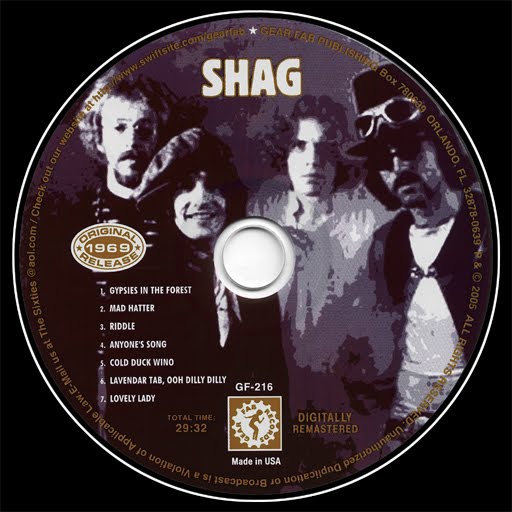
Shag - Shag (1969 us psychedelic tinged hard blues with very good heavy fuzz guitar - 2005 Gear Fab records edition - FLAC)

First based in Milwaukee band, The Shag released, over the 60’s two punk/garage singles (the first one under the name The Shags), which are to be found on various compilations.

In 1969 the final version of the group, which now had moved to California also have recorded a full album of material at “PHR” at the open hours when Grateful Dead were not recording and creating their “Working Man’s Dead”.

Although the recordings were promising they never got a record deal with it and they remained unknown and unreleased until now.

Here the group plays hard, mostly bluesy, psychedelic rock with great fuzz guitars and a good rhythm section, as perfect music for night club performances, not only suitable to get drunk on beer to.

“Gypsies on the Forest” is my favourite track, -a classic if you ask me, a bit reminiscent of Rufus Zuphall-, which is very rhythmic-melodic and has great rocking flute.

“Mad Matter” has a great late night fuzz jam rock drive, and some mad laughter on the background.

“Riddle” is a harder rock song, while “Anyone’s Song” is an ok common ’baby' rock song.

“Cold Duck Wino” continues this way slightly more calmy rocking, with fine fuzz solos.

"Lavender Tab, Ooh dilly dilly" is like the first track, has again a partial rhythmical-melodic partly song drive, while "Lovely Lady" rhythmically is a calmer rock song with some more fuzz (by progressive.homestead.com).

Track List:
01.Gypsies In The Forest (03:06)
02.Mad Hatter (02:58)
03.Riddle (02:47)
04.Anyone's Song (02:46)
05.Cold Duck Wino (06:17)
06.Lavendar Tab, Ooh Dilly Dilly (07:26)
07.Lovely Lady (04:08)

Shag:
*Gordon Elliott: lead guitar, lead vocals, harmonica, conga drums
*Don Luther: bass guitar, vocals, percussion
*Green Greenwald: alto & soprano flutes, sax, drums, wurlitzer piano, vocals, percussion
*Michael Lamers: rhythm guitar, drums, autoharp, vocals, theremin, whistles, gongs, percussion


[ Thank you BOBO59 for sending this post ]
Rip and scans made by FLOGGER77
CODE: 52959

Tuesday, May 24, 2011

Al Kooper - Rare & Well Done (1964-2001 us, psychedelic rock, rhythm and blues, pop, country and jazz, remaster edition - MP3 320k and FLAC)

Rare & Well Done, is a two disc collection that fully represent the album's title. All the tracks were 24-bit remastered with Kooper's own supervision. Disc one is a 19-track collection of hard to find and previously unreleased material from the Kooper vaults, while disc two features plenty of the artist's best known work, in solo and various band formats. For longtime fans, this collection is a welcome addition to their Kooper collection. For anyone else who's even mildly curious about Kooper's legacy, this album works as a nice springboard from which to begin exploring the man's vast catalogue. As it usually is with such releases, not everything here works and not every "rare" found here needed inclusion, but overall Rare & Well Done is an indispensable look back at one of rock music's most prolific artists.

The "Rare" disc opens with a new demo, "I Can't Quit Her 2001". It's not the best song on the disc that the collection could have started with. In fact, it's a bit schmaltzy and sounds like something that you might hear Paul Schaffer's band doing on Letterman. It's certainly not the best version of this classic, as the live version included on the "Well Done" disc proves. However, things fall into place and start to genuinely rock with track two, Kooper's 1964 demo of "Somethin' Goin' On". Amazingly soulful, gospel tinged and incredibly deep, "Somethin' Goin' On" seems light years away from everything else that was coming out in '64 -- especially Beatlemania. Kooper's voice instantly moves one emotionally as much as those fantastic piano, organ, and guitar parts. Stunning. But then again, the disc manages to dip down for a moment as "Autumn Song" sounds like a mid-'80s fusion/muzak piece.

It would have been better had the contents of this disc been arranged chronologically as the time warps back and forth through the years certainly mess up the grooves more than once. Kooper's own phrasing of some of the words here, like "winter" also seem a bit silly as if he were just goofing off on the track. "I Can't Stand The Rain" which follows is a bit better, though the horn section sounds like nothing more than synth brass. These are the kinds of rarities that may have been better off left on the shelves. Still, one can't argue with the slow cooking "Baby Please Don't Go" offered here in a live version from 1971 and getting and eight-and-a-half minute workout. Kooper's amazing piano work on the track just simply burns, as does his vocal prowess once again.

Giving Big Joe Williams a run for his money, "Baby Please Don't Go" encapsulates not only the blues here, but also takes on funk and classical vestiges that must simply be heard to be appreciated. The band's solo spots are equally remarkable, with the other-worldy synth break being especially dazzling. But then the record shifts once more and we're back into smoove rock territory with "I Let Love Slip Through My Fingers", a number on which Kooper seems to be doing his best Lou Rawls impression that turns out to be not so good in the end. The sax and guitar parts are overwrought and cheese up the track way too much. "The Earthquake of Your Love" restores the good groove with an undeniably Seventies bounce and charm.

This time, Kooper vocally sounds almost like Steve Miller. And that's not too strange, considering Miller himself went on to create such plastic, yet likable boogie like "Abracadabra" a bit later on. Getting back to the downright essential tracks on the disc, of important note is the inclusion of Al's very first single from 1965, "New York's My Home (Razz-A-Ma-Tazz)". Again, this long lost Sixties chestnut doesn't sound much like anything else going on at the time with its pretty flute and string arrangement outdoing the Fab Four (again), and that indelible swinging jazz outbreak at the middle of the tune being especially captivating. If Kooper wasn't influencing both Brian Wilson and Lennon and McCartney at this time, then I'd damn sure be surprised as Al had created his own "mini-epic" right here . . . in 1965 . . . in two-and-a-half minutes.


The "English Hall" cover of XTC's "Making Plans for Nigel" is also excellent. Dare I say that it's even better than XTC's. Sure. I'm not so taken with that group that I can't see that their career has been spotty through the decades. But even better than that is Kooper's blistering version of Dylan's "Went To See The Gypsy", an outtake from Bob's New Morning LP that rock fiercer than Dylan's own take. Of course, that version was so subdued (yet equally great) that it wouldn't be difficult to rock harder. But here, Kooper's band injects stunning guitar parts that do sound distinctively Sixties, but all the better. Also of interest is Kooper's instrumental rehearsal version of "Hey Jude" from 1969 with orchestra. Kooper jazzes the Beatles tune up with swinging horns and lickety-split drumming. It sounds a bit like a Vegas spectacular, but it's by no means horrible.

Hearing someone with Kooper's talent reconfigure such a song in this format is impressive. Although it is hard not to laugh at "The Big Chase", a piece of incidental music that was left out of an episode of TV's Crime Story. It sounds like Jan Hammer and Harold Faltermeyer got together and created the most hellish cop music they could think of. Lots of fun (seriously). Turning to the "Well Done" disc of the collection now, the old fans should finally start feeling like they're on familiar territory as nothing on the CD here hasn't been released before. Things start with a live 1994 take of "I Can't Keep from Cryin' Sometimes" recorded with the Blues Project. Once again, Al is in his element when he has a band behind him that complements his own talent. The organ work, the guitar licks are both hot, and Kooper puts in some of his most soulful vocalizing. Tasty.

Set the Way Back Machine for 1968 then, because it's time to hear Blood, Sweat and Tears' "I Love You More Than You'll Ever Know". Again, there's a stunning amount of soulfulness ripping through this track with the undeniable organ and vocal parts (especially those of the backup singers). A slow burner if there ever was one, it's followed up with a 1975 version of "This Diamond Ring" complete with funky keyboards a-la Billy Preston's "Outa Space". Personally, I dig this version a lot more than the original by Gary Lewis and the Playboys.

There's still no getting over the Kooper/Bloomfield (as in Mike) number "Albert's Shuffle" from '68. Here it is once again in all of its blistering glory. The blues as pounded out by two of the best. All you have to do is hear that organ and guitar and those horns and that's all it takes. Next thing you know, you're somewhere else. All great music should move you. Here's a number that does it every time. And the movement continues with the classic "Bury My Body" recorded with Shuggie Otis in 1969 and "Season of the Witch" with Stephen Stills in 1968. It's truly a joy to hear Kooper's phenomenal work from the Sixties here all laid out.

The man was clearly an inspired and enviable musician at that point in his career. "New York City (You're A Woman)" is also great. Here, Kooper's organ sounds just like Booker T.'s good old Hammond B-3. And who could forget such brazen opening lines like "New York City you're a woman / Cold hearted bitch ought to be your name / Oh you ain't never loved nobody / Yet I'm drawn to you like a moth to flame/ . . . Yeah"? This piece of classic funkiness is then followed with a damned great live version of "I Can't Quit Her" from 1994 that shows just how great the song really is (you wouldn't know it from that limp version that opened the "Rare" disc as stated earlier).


The classics just keep on coming from there, from the fantastic "I Stand Alone" to another slow burner, this time in the form of "I Got a Woman". Also included is the closing "Love Theme from The Landlord", which is the only Al Kooper disc not currently on CD. All in all, "Well Done" lives up to its name and then some It's just too bad that the "Rare" portion of this collection didn't include an equal portion of indispensable tracks. The nuggets from the Sixties and Seventies are cool and wonderful, but with only a couple of exceptions, like "Making Plans for Nigel", and "The Big Chase", the rest of the rarities kind of bring about a cringe-inducing element, proving once and for all that there was a very good reason a lot of the tracks here were previously unissued.


Yet the "Well Done" disc is impeccable, making this collection a must-have. It's great to have all these tracks in once place. Al Kooper continues to play a highly influential part in the music industry. His well-documented history up this point has been preserved beautifully and put on display for all to hear in this collection.
Thanks for the memories, Al (by Jason Tompson).

Disc 1
1.I Can't Quit Her (Kooper/Levine)
2.Somethin' Goin' On (Kooper)
3.Autumn Song (Kooper)
4.I Can't Stand the Rain (Bryant/Miller/Peebl)
5.Baby Please Don't Go (Williams)
6.I Let Love Slip Through My Fingers (Kooper)
7.The Earthquake of Your Love (Kooper)
8.Bulgarya (Kooper)
9.Nuthin' I Wouldn't Do (For a Woman Like You) (Kooper)
10.New York's My Home AKA the Street Song [Razz-A-Ma-Tazz AKA the Street (Kooper)
11.Making Plans for Nigel (Moulding)
12.I Believe to My Soul (Charles)
13.Went to See the Gypsy (Dylan)
14.Rachmaninoff's Birthday (Kooper)
15.Hey Jude (Lennon/McCartney)
16.Living in My Own Religion (Kooper)
17.The Big Chase (Kooper/Calello)
18.They Just Don't Make 'Em Like That Anymore (Kooper)
19.A Drive Through the Old Neighborhood (Kooper)

Disc 2
1.I Can't Keep from Cryin' Sometimes (Kooper)
2.I Love You More Than You'll Ever Know (Kooper)
3.This Diamond Ring (Kooper/Levine/Brass)
4.Albert's Shuffle (Bloomfield/Kooper)
5.Bury My Body (Kooper/Price)
6.Season of the Witch (Leitch)
7.New York City (You're a Woman) (Kooper)
8.I Can't Quit Her (Kooper/Levine)
9.I Stand Alone (Kooper)
10.Flute Thing (Kooper)
11.You Never Know Who Your Friends Are (Kooper)
12.I Got a Woman (Charles/Richard)
13.Brand New Day (Kooper)
14.Love Theme (Kooper)

Other releases by Al Kooper, posted on PHROCKBlog
1968 - Child Is Father to the Man with Blood, Sweat & Tears
1968 - Super Sessions with Mike Bloomfield and Steve Stills
1968 - Fillmore East The Lost Concert Tapes 12/12/1968 with Mike Bloomfiled
1968/1969 - I Stand Alone/You Never Know Who Your Friends Are...Plus
1969 - The Live Adventures Of Mike Bloomfield and Al Kooper
1969 - Kooper Session - Al Kooper introduces Shuggie Otis
1970 - Easy Does It

[ Rip and Scans by MARIOS ]
Previous posted at PHROCK on Thursday, May 28, 2009
CODE: 52608

Friday, May 20, 2011

49th Parallel - The Best Of 49th Parallel (1967-1970 us psychedelic and pop psych - 1995 pacemaker records compilation - FLAC)

Calgary, Alberta's 49th Parallel were originally known in the mid-60's as a popular bar band by the name of The Shades Of Blond.

With a stifling and musically limiting Calgary club scene they were never able to get farther than having one single -- 1966's "All Your Love".

The tune would eventually pop up on a (now rare) 4 song EP next to an early incarnation of The Stampeders.

As members came and went a name change was introduced as 49th Parallel and over the course of a year a solid line-up developed featuring Abbott, Lowe, Carlson, Petch, Woodhouse and Bare.

The group released three singles on Gaeity Records between mid-1967 and late spring of 1968, at which time Petch and Woodhouse left and Dave Downey was added as bassist (Petch was not replaced).

Throughout 1968 and parts of 1969 they toured throughout North America with an ever fluctuating roster. Despite these shake ups, they did hit and run recording sessions which bore several singles for Venture Records including "Twilight Woman" that managed seven weeks on the CHUM charts with a peak position of #16 in April 1969, and its follow-up, "Now That I'm A Man", in September 1969 which managed a modest 3 week ride on the CHUM charts and a peak position of #22.

A full-length album was hastily assembled from singles and studio outtakes because the line-up was continually fluctuating and new recordings were impossible to conduct.

This would be compounded by the immediate departure of singer Dennis Abbott following the album's released.

Enter Dorn Beattie, who, along with Lowe, Velker, Downey and Bare began working on another album in 1970 which was never completed, though the single, "I Need You", did surface (and failed to chart).

Eventually the band changed its name to Painter and released one album before mutating into the hard rock act Hammersmith who would finally succumb in the late '70's after two albums on Mercury Records.

Beattie went on to create All The Rage In Paris, but that too faltered when co-founding keyboardist Doug Johnson quit to form Loverboy. Beattie, in recent years, is now a successful country singer; Lowe continued on with a new version of Painter, 451 Degrees, and Prototype (who also recorded an album).

He produced albums by Qwest, Whitewolf, George Fox, Amin Bhatia, and would also be responsible for the invention of the studio production technique called Q-Sound (used by such luminaries as Pink Floyd, Bob Ezrin and Madonna)

49th Parallel found a mild revival in the mid-90's on classic rock radio in the prairies, prompting Pacemaker Records to issue a 'best of' collection (With notes from Bill Munson and Jack Velker).

Singles
as SHADES OF BLOND
1966 All Your Love

as 49th PARALLEL
1967 Labourer/You Do Things (Gaiety)

1968 She Says/Citizen Freak (Gaiety)
1968 Blue Bonnie Blue/Missouri (Gaiety)

1969 Twilight Woman (Venture)
1969 Now That I'm A Man (Venture)

1970 I Need You/Goodtime Baby (Venture)

Albums/CDs
1969 49th Parallel (Gaiety)

1995 The Best Of 49th Parallel (Pacemaker)

Compilations
1999 "Citizen Freak" on 'Best Of Gaeity Records' (Pacemaker)

Labourer:


Track List:
01.Labourer
02.You Do Things
03.Citizen Freak
04.She Says
05.Blue Bonnie Blue
06.Up To No Good
07.Now That I'm A Man
08.Get Away
09.Eye To Eye
10.Missouri
11.Lazerander Filcny
12.(Come On Little Child) Talk To Me
13.Magician
14.Twilight Woman
15.Close The Barn Door
16.The People
17.Good Time Baby
18.I Need You
19.Shades Of Blond/All Your Love

49th Parallel:
*Dennis Abbott (vocals)
*Dan Lowe (guitar)
*Bob Carlson (guitar)
*Dave Petch (organ)
*Mick Woodhouse (bass)
*Terry Bare (drums)
*Dave Downey (bass; replaced Woodhouse)
*Alf Cook (bass; replaced Downey)
*Dennis Mundy (organ; replaced Petch)
*Jack Velker (organ; replaced Mundy)
*Dorn (Doran) Beattie (vocals; replaced Abbott)


[ Thank you MCLEHAST for sending this post ]
Rip and scans made by torrents
CODE: 52473

Wednesday, May 18, 2011

Roger Bunn - Piece Of Mind (1969 uk, exotic, psychedelic, free jazz rock, progressive with smoky moments, paper sleeve edition - MP3 320k and FLAC)

July 2005, what pundits and journalists have termed "the most important rediscovered 60s classic", the album with Roger Bunn singing his own and a number of poet John Mackie lyrics, Piece of Mind was brought back into "the arts" and onto the market.

Vocalist, composer, master guitarist, double and electric bass player, and long standing human rights activist Roger Bunn, worked with dance orchestras, blues bands and jazz groups, including the original Blue Notes from South Africa and the Spontaneous Music Ensemble.

In 1968 David Bowie recorded Roger's classic "Life is a Circus" and through being careless with his copyright, allowed this early 60s song to fall into the hands of pirates.
Nowadays we're all fans. Or at least we're told we should be. We need to be entertained and demand new familiar or not-so-familiar sounds to satisfy our consumer instinct. For many, music is more about selling and buying than creating.

Looking back at "psych" music we can check any number of musical commodities and ask ourselves, "Was it pop with ornamentation or something heavier and far-out?" In our disposable age it's hard to see the effect that an album could have artistically, especially in retrospect. Bands now are happy to ape each other with ironic glee or frustration for a time when pop music seemed very important.

The frustration also seems to be with the overwhelming entertainment directive that guides so many of our lives.
But in 1969 Roger Bunn put together "stream-of-consciousness" words with jazz rhythms and acid-psych, punctuated by the occasional James Brown horns, to make a unique album. How many albums, even in the sixties, captured the real sense of unknown territory evident in Ken Kesey's "Merry Pranksters" bus rides? All through "Piece of Mind" we hear songs that have the same mythic sense of exploration that was about more than fashion and drug use. The need to entertain is certainly not just a new phenomenon.

Even the Beatles "Magical Mystery Tour" seems pulled between the demands of well-crafted radio-friendly pop expectations and the sense of abandon and new territory suggested by psychedelia. They pull it off pretty well of course (as they tended to do), but one could argue that this split between commercial expectation and artistic development is really what broke up the Beatles in the end. "Magical Mystery Tour" (the film anyway) certainly didn't go down very well at the time, and it seemed to be a possible sign of self-indulgence.

But maybe in retrospect we can see that it was just a sign of the complexity of the times and the difficult balance that's needed to recreate an experience that is truly internal and "psychedelic" in a way that can be enjoyed by all.
With "Piece of Mind," we have a real testament to one person's take on many of the influences of the time, and the journey is definitely as inward as it is outward.

Looking back, there will be those who prefer more pop with psychedelic tinges in their music, as well as more accommodations for listeners who want their music a certain way. But this is an album that sets its own standard. While the Doors plastered some jazz chord changes onto "Light My Fire," they also couldn't escape the blues background that placed them firmly in a traditional setting. "Piece of Mind" is part jazz as well, but the sound changes from song to song, and it points towards the experimentation of bands like Can, Agitation Free, and the German rock of the 1970's. Listeners may hear cues from folk, jazz and psychedelia, but it's really an album "sui generis" that stands out as an anomaly.

People may love it or hate it, but that could well have something to do with where this album points towards, and the listener's attitude about the developments in music and marketing that occurred throughout the seventies.
Regardless, this James Brown meets Arthur Brown meets Pete Brown sort of eclectic style is definitely ahead of its time. Although there is some folk and plenty of acoustic guitar to be heard, this is not a traditional album.

The reference guide "Tapestry of Delights" calls Roger Bunn's "Piece of Mind" 'weird but serious pop-sike.' You can hear that in the album along with a whole lot of other sounds. Meeting Roger one afternoon and listening to him weave a conversation from history and religion through politics and music, (the whole time accompanied by gentle improvisation on his electric guitar), I could tell that this was a person who puts a lot of himself into what he does.

"Piece of Mind" is definitely of a time, but as a message from Roger himself, it also makes you see the artificial limits of our rush for "new" sounds and things. There is new and old, and then there is truly adventurous music. "Piece of Mind" has some of the sound of a particular time in musical history, but it also has the enduring sound of someone trying something different. And it's that second part that goes a long way towards explaining the difference between commodity-based entertainment and art.
by Joe McFarland


Pete Drummond - BBC 1970 said: "It is a wonderful album. It's far too musical and intelligent to succeed."


Tracks
1. Road to the Sun (Bunn) - 5:37
2. Jac Mool (Bunn, Mackie) - 0:44
3. Fantasy in Fiction (Bunn) - 1:35
4. Jac Mool (Bunn, Mackie) - 0:16
5. Crystal Tunnel (Bunn, Mackie) - 2:57
6. Three White Horses (Bunn) - 2:43
7. Catatonia (Bunn, Mackie) - 1:33
8. Suffering Wheel (Bunn, Mackie) - 1:40
9. Guido the Magician (Bunn, Mackie) - 2:45
10.Powis Square Child (Bunn, Mackie) - 2:30
11.Old Maid Prudence (Bunn, Mackie) - 5:21
12.Humble Chortle (Bunn, Mackie) - 1:52
13.Jason's Ennui (Bunn, Mackie) - 3:52
14.110° East + 107° North (Bunn) - 3:21
15.A Weekend in Mandraxia (Bunn) - 6:08
16.Life Is a Circus (Bunn) - 6:14
17.Falling Ships (Bunn) - 3:20
18.In the Future (Bunn) - 3:29
19.Lin-da's Jukebox (Bunn) - 5:58
20.You and I (Bunn) - 3:43
21.In Love with You Babe (Bunn) - 4:24
22.Up for Grabs (Bunn, Pete Brown) - 5:47

*Roger Bunn - Guitars, Vocals, Bass
*Ruud Bos - Conductor (1-14)

[ Rip and Scans by MARIOS ]
CODE: 51960